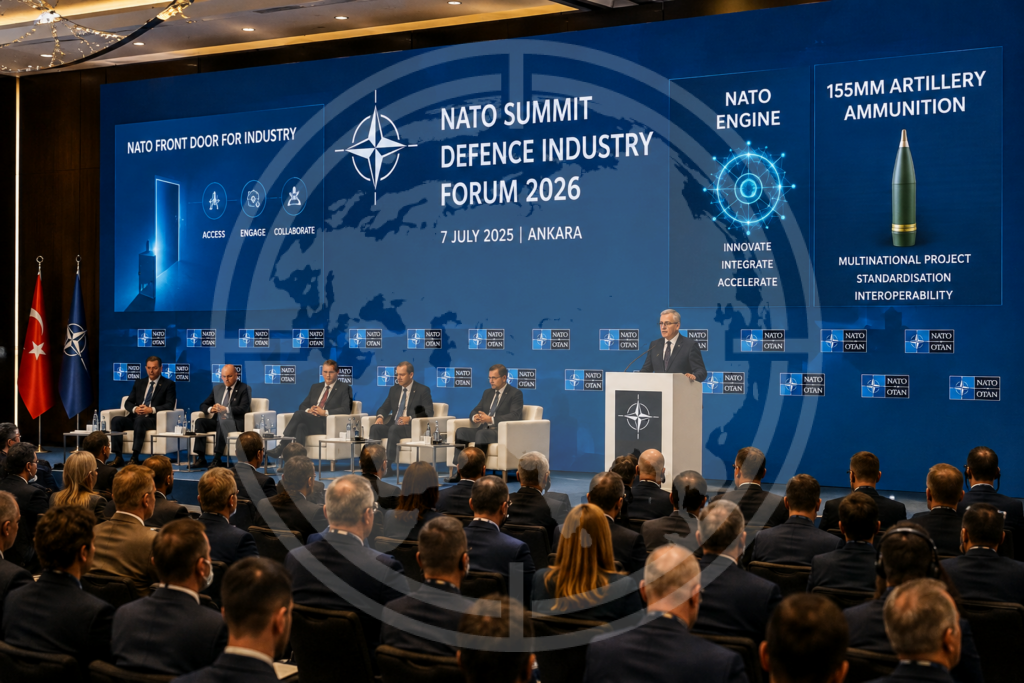
Defence budgets are growing, yet stockpiles are being depleted faster than manufacturers can replenish them. Between funding allocated on paper and ammunition delivered to the armed forces lies a complex chain involving raw materials, machinery, certification and logistics. Bridging this gap is precisely what NATO is now seeking to achieve.
On 7 July 2026, the NATO Summit Defence Industry Forum took place in Ankara.
NATO Secretary General Mark Rutte outlined the underlying challenge: no single country has the industrial capacity to meet rising demand, particularly for air defence and strike capabilities. Against this backdrop, four practical initiatives were presented.
- NATO Engine: Putting Existing Industrial Capacity to Work
This mechanism connects companies struggling to scale up production with manufacturers that have spare capacity. Civilian industrial operators can also participate, including through arrangements that allow production to be carried out at third-party facilities.
However, having an available machine does not automatically make a facility suitable for defence manufacturing. Compliance with technical specifications, process oversight, information security, appropriate authorisations and quality assurance are all essential.
The initiative is currently being run as a pilot project scheduled to operate from July 2026 through December 2027. - NATO Front Door for Industry: One Point of Access Instead of a Complex Maze
Companies with relevant expertise often lack a clear understanding of where NATO identifies its requirements or which channels they should use to engage with the Alliance.
The new platform brings together procurement opportunities, innovation events and industry engagement channels in one place. NATO will also publish an unclassified list of priority requirements and technological needs developed by the Alliance’s defence planners.
For manufacturers and suppliers, this creates an opportunity to anticipate emerging demand and establish partnerships accordingly. However, access to information does not guarantee a contract. Any subsequent decision will still depend on technical compliance, qualification procedures and applicable export restrictions. - GENIFR: Standardising Calibre and Ensuring Interoperability
Nine Allies — Canada, the Czech Republic, Denmark, Finland, Greece, Norway, Slovakia, Sweden and Türkiye — have agreed to work on a prototype for a
standardised 155 mm artillery round under the Generic NATO Indirect Fire Round (GENIFR) initiative.
A common calibre does not necessarily mean that ammunition is interchangeable.
Differences between weapon systems complicate stockpile management, manufacturing processes and the allocation of resources.
If trials confirm the proposed level of standardisation, manufacturers will be better positioned to serve multinational requirements, while procurement authorities will gain greater flexibility in sourcing ammunition.
Nevertheless, a new round will not automatically be compatible with every existing artillery system. Testing, certification and verification of safe operation will remain essential. Nor does this mean that current ammunition types will become obsolete or disappear from service. - Raw Materials: The Most Critical Constraint
Twelve Allies have signed a Memorandum of Understanding on cooperation in critical raw materials for defence. The agreement provides for coordinated procurement, a multinational network of storage facilities, transport arrangements and the development of strategic reserves.
A factory cannot operate without materials, regardless of whether it has the necessary equipment, workforce and contracts. Within defence supply networks, the key considerations extend well beyond price. Material origin, delivery predictability, geographical concentration of production and transportation risks all influence the reliability of industrial output.
The Bigger Picture: A Structural Shift in NATO’s Industrial Policy
Alliance leaders have adopted the NATO Strategy for Industrial Cooperation (NSIC), placing industry at the centre of defence planning. They have also agreed to invest more than $40 billion over five years in counter-drone capabilities.
Taken together, these measures point to a structural transformation of the defence industrial base rather than a one-off public relations exercise.
Conclusion
The next stage of defence market development will be determined not by the amount of money allocated to military spending, but by how efficiently that funding is converted into finished products and delivered capabilities.
The strongest position will belong to those able to bring together technical requirements, available manufacturing resources and dependable international supply channels.
This is precisely where AKM GROUP-CZ operates. Professional coordination between procurement authorities, manufacturers and international partners is no longer simply an additional service. It is becoming a prerequisite for effective participation in NATO’s evolving industrial framework.