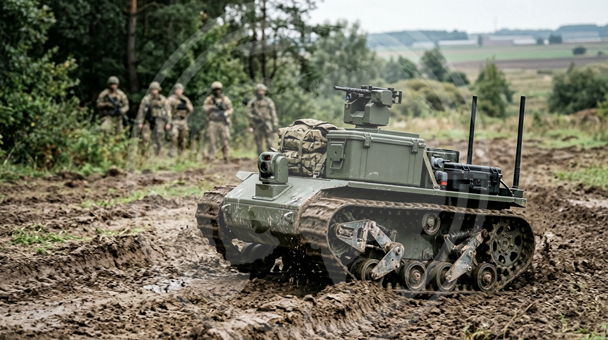
When the last kilometres to the front line are covered by FPV drones, sending people there in pickup trucks or on foot means accepting unjustifiable risk. The only answer is remotely operated machines capable of performing combat tasks. Unmanned warfare is therefore no longer associated with the sky alone: it has descended to the ground. In 2026, the global market for military and specialised unmanned ground vehicles (UGVs) reached $3.2 billion, with growth forecast to $5 billion by the early 2030s. The United Kingdom, for example, purchased a batch of high-tech robotic sapper vehicles, spending £32 million.
Statistics from the main proving ground of modern warfare, the Ukrainian front, are telling. According to the DELTA system of Ukraine’s Ministry of Defence, in the first half of this year the military carried out more than 66,300 logistics and casualty evacuation missions using ground robots, and the state has contracted more than 22,000 new platforms.
From the First World War to Intelligent Chassis
The idea of sending a machine toward enemy fire in place of a soldier was born in the last century. The first prototypes appeared during the First World War: in 1915, France developed the Torpille Terrestre, an electrically driven “land torpedo” for destroying fortifications, controlled by wire. The Second World War saw the German Goliath tracked mine and the Soviet TT-26 teletank. All of them suffered from cable breakage and limited range.
The real technological breakthrough came at the start of the 21st century with the American PackBot and TALON sapper robots, which saved lives in Iraq and Afghanistan by neutralising improvised explosive devices (IEDs). Even then, however, UGVs remained a narrowly specialised tool of engineer units. Today they are mass-produced, multi-role equipment.
A New Role at the Front
Only a few years ago, most ground drones resembled simple radio-controlled vehicles for delivering water and ammunition. Requirements have changed. The market now demands fully capable unmanned platforms that can operate in a danger zone with minimal human involvement.
- Logistics and evacuation under fire. Robots take on the riskiest tasks: delivering ammunition, fuel and engineer obstacles to the forward line, and evacuating the wounded from under bombardment.
- Remote mine-laying and clearance. Platforms covertly emplace mine barriers or clear safe lanes for assault groups, working the minefield in place of sappers.
- Fire support and reconnaissance. Demand is shifting rapidly toward heavy, protected chassis with integrated weapon modules. A robot armed with a machine gun, grenade launcher or anti-tank missile system can hold a position, cover an infantry withdrawal or engage from a concealed point without endangering an operator.
What Scaling Requires
The number of UGV models has grown substantially, and with it the need for reliable, standardised components. For a ground drone not to become a disposable toy after its first encounter with rough terrain or hostile EW, it needs a flawless engineering base.
Traction drives and gearboxes. Motors must withstand peak loads, mud and water, while carrying payloads from 200 kg to a tonne over difficult terrain.
High-capacity battery systems. Batteries adapted to temperature swings, delivering tens of kilometres of range under load without critical loss of power.
Secure communications and navigation. Jam-resistant systems able to sustain a stable video link and control in GPS-denied environments or via relays.
Thermal optics and stabilised turrets. High-resolution sensors for operation at night and in smoke, along with compact remote weapon stations that integrate easily with different chassis types.
The AKM Group-CZ Engineering Perspective
With experience in defence supply and engineering developments of our own in the unmanned ground platform segment, we see the market from two sides: as developers and as an international integrator. Today, the success of any UGV project is determined not only by the originality of its exterior but by the quality of the components inside. By combining proven solutions from world-leading manufacturers of optics, communications, drives and weapon systems with the real requirements of modern combat, we work with our partners to create machines that will perform effectively at the front. After all, the central mission of any military technology remains unchanged: to reduce risk to people to a minimum.